QuantumBox – Real-Time Photon-Number-Resolving Detection Chain
QuantumBox is a fully digital readout and signal-processing chain for photon counting and time-tagging in SiPM-based quantum optics. Powered by the DAQ141 digitizer family with dedicated firmware and software, it counts the exact number of photons in every trigger event — replacing the legacy analog boxcar / gated integrators that can barely operate above a few kHz — in a single, compact, room-temperature unit.
Not just “click / no-click” — the real photon number. A single-photon avalanche diode (SPAD) is a binary detector: it can only tell you whether at least one photon arrived or not, saturating as soon as two or more photons hit it together. By coupling a SiPM — a matrix of thousands of Geiger-mode microcells, each firing independently — to a high-speed 1 Gsps / 14-bit acquisition system, QuantumBox instead resolves the exact number of photons that arrive simultaneously in the same pulse, one discrete peak per photon. This true photon-number resolution (PNR) is what turns a yes/no event into a quantitative, photon-by-photon measurement of the light field.
Where a conventional chain needs a rack of analog electronics, a slow gated integrator and an external PC doing offline analysis, QuantumBox does everything online, in the FPGA: it digitizes each SiPM pulse at 1 Gsps / 14-bit, restores the baseline, deconvolves the detector response, integrates the charge, assigns the photon number and streams a per-pulse event list — at trigger rates up to 40 MHz on all channels at once, with 50 ps time-tagging and a 7× lower noise floor than analog integration.
The detection chain at the core of QuantumBox is described and characterized in the peer-reviewed work “Developing a photon-number-resolving detection chain for quantum communication protocols involving mesoscopic states of light” (Pozzoli, Carsi, Abba, Allevi — University of Insubria & Nuclear Instruments, 2026) — a real scientific application of the system.
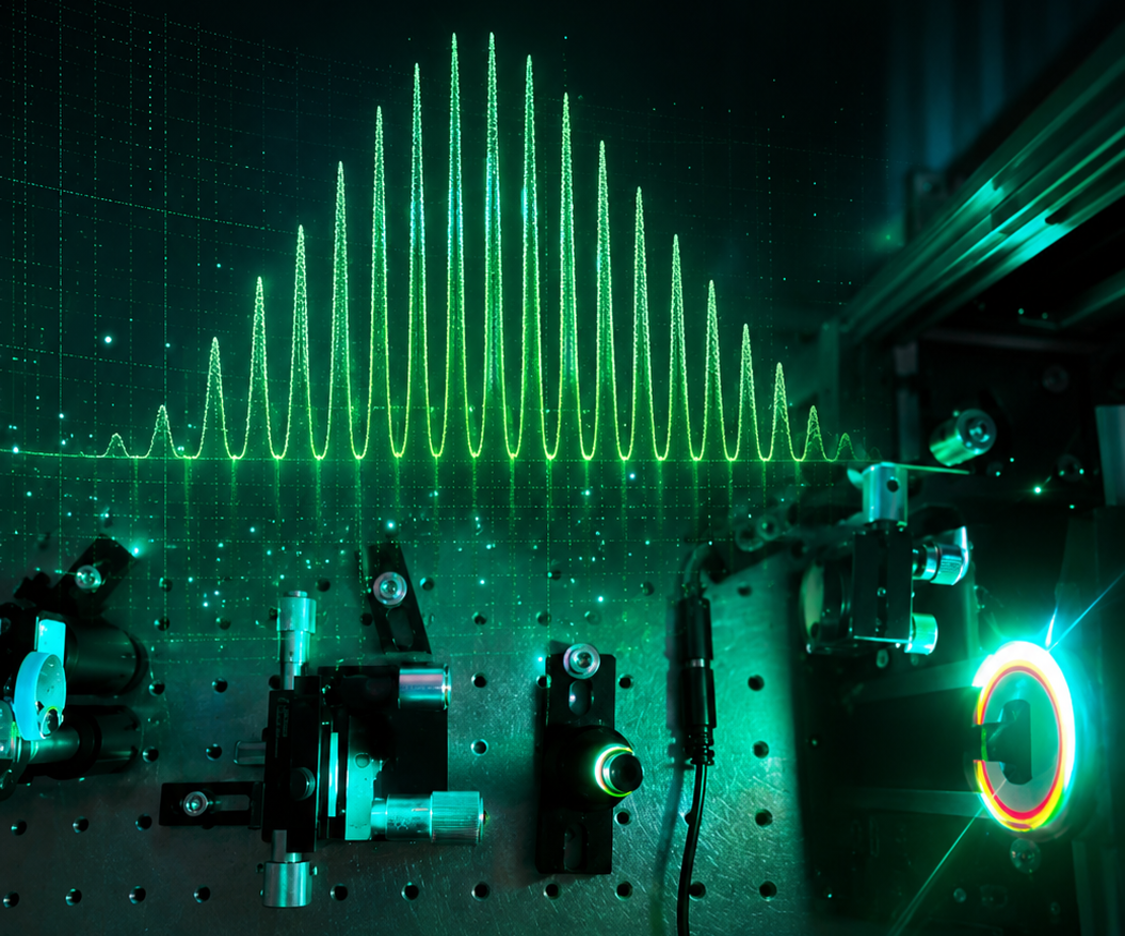
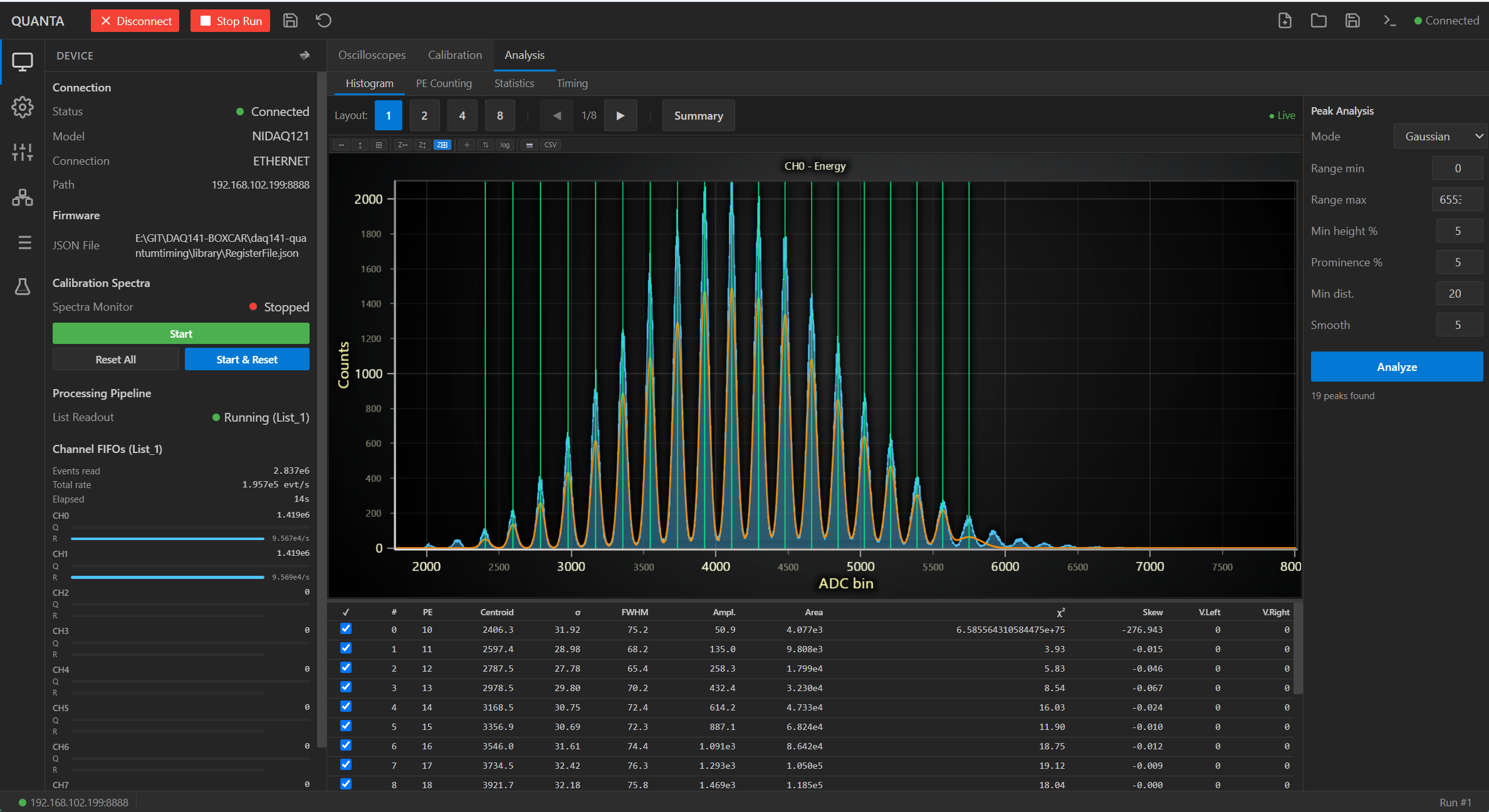
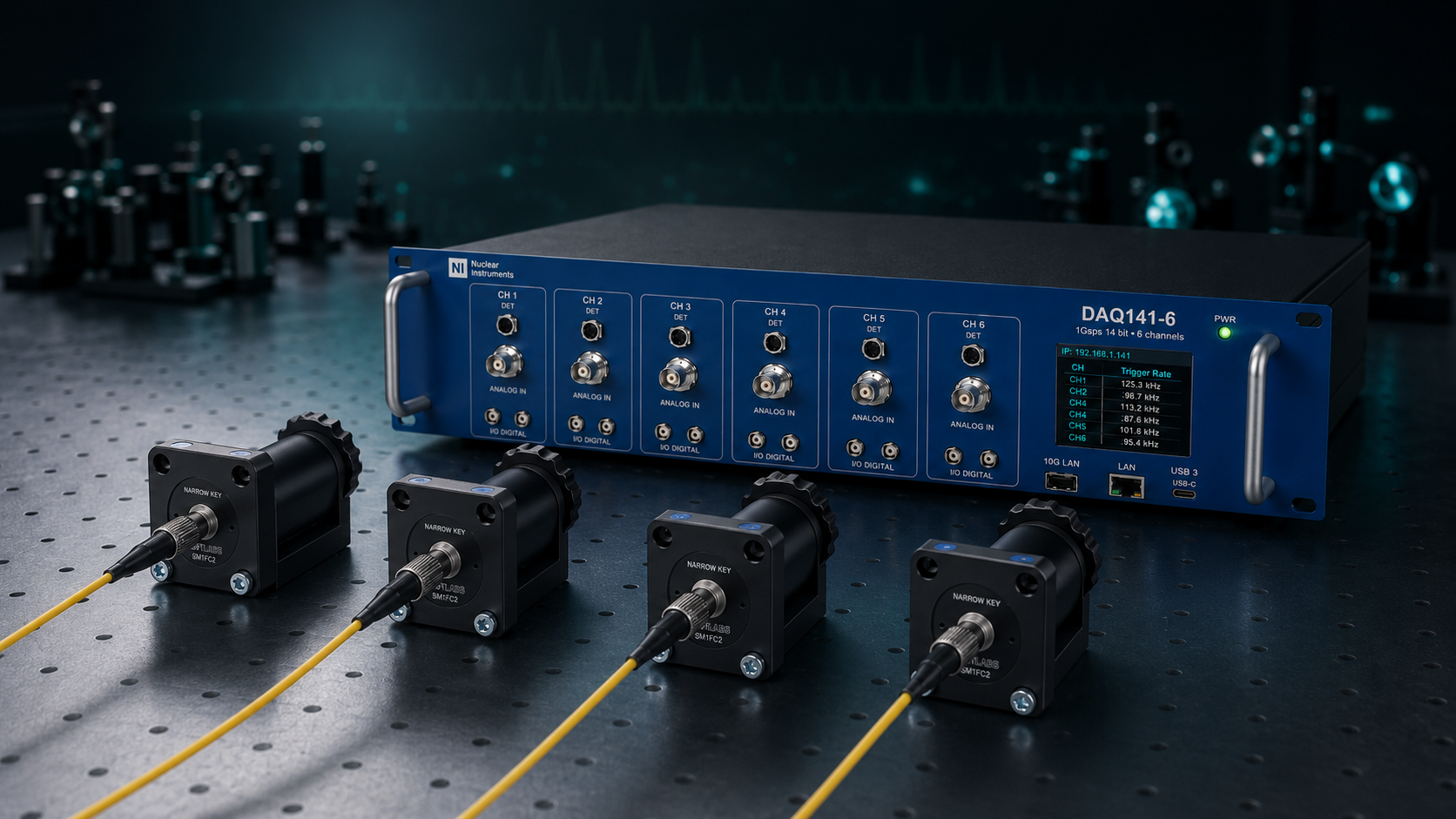
A measured photon-number spectrum overlaid on the quantum-optics bench: every peak is a discrete number of detected photons, resolved in real time by QuantumBox.
A measured photon-number spectrum overlaid on the quantum-optics bench: every peak is a discrete number of detected photons, resolved in real time by QuantumBox.
The QuantumBox Chain
QuantumBox replaces the entire analog processing chain downstream of the SiPM with a deterministic digital pipeline running inside the digitizer FPGA. Because the processing is digital, identical settings give identical results regardless of temperature, drift or ageing — and every parameter is tunable at run time, with no firmware recompilation.
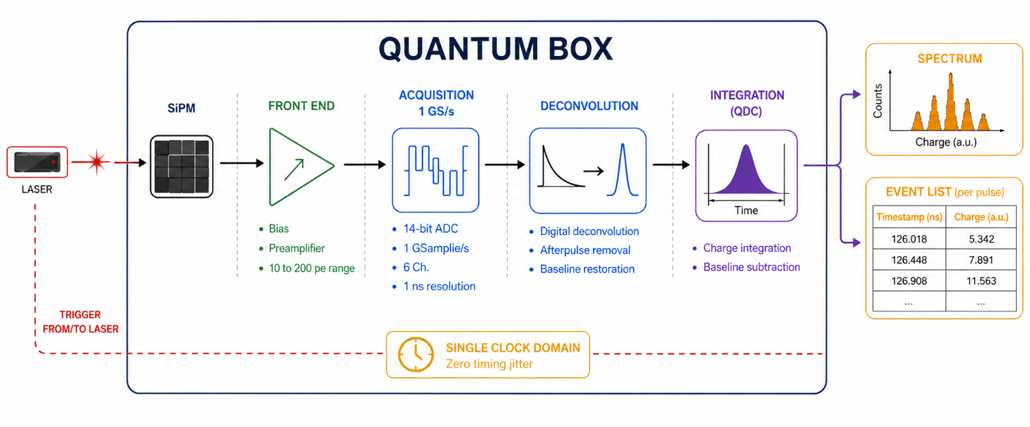
The QuantumBox processing chain: SiPM → front-end → 1 Gsps / 14-bit acquisition → digital deconvolution → charge integration (QDC) → photon-number spectrum and per-pulse event list. Laser and digitizer share a single clock domain for zero timing jitter.
The QuantumBox processing chain: SiPM → front-end → 1 Gsps / 14-bit acquisition → digital deconvolution → charge integration (QDC) → photon-number spectrum and per-pulse event list. Laser and digitizer share a single clock domain for zero timing jitter.
Real-Time Operations
Every stage of the analysis is performed online, event by event, by the QuantumBox firmware and the QUANTA software — no offline post-processing is required. As each trigger arrives, the full chain executes within the FPGA before the next pulse:
- Synchronous triggering & gating — a leading-edge discriminator opens the integration gate in lockstep with the trigger. The trigger can be external (a photodiode sampling the laser pulse) or generated internally by the digitizer, which then drives the laser so that detector and source share one clock domain — reducing the aperture jitter of the integration window to a few picoseconds.
- Baseline restoration — the signal baseline is continuously estimated as a moving average and subtracted, so every downstream stage works on a zero-mean signal; estimation is inhibited during the pulse so it cannot bias the measurement. Removes DC drift and offset for an accurate charge measurement.
- Digital deconvolution (pole-zero) — a digital filter inverts the quasi-exponential amplifier response at the full sample rate (one output every 1 ns), recovering the original fast charge spike and rejecting dark counts and afterpulses. Avoids ballistic deficit and keeps the photon-number peaks sharp.
- Charge integration / QDC — the deconvolved waveform is integrated over a short, configurable gate (~10–20 ns), producing a single scalar charge value per pulse proportional to the collected light. Programmable digital delay lines position the gate precisely on the pulse. The short, well-placed gate captures only the fast SiPM charge, suppressing uncorrelated dark counts and afterpulses.
- Photon-number assignment & live spectrum — the firmware builds the pulse-height (photon-number) spectrum in real time; each peak is a discrete number of detected photons (photo-electrons). This is the photon-number-resolving readout — charge values become photon-number histograms online.
- Per-pulse, multi-channel event list — for every trigger the integrated charge of all channels is streamed simultaneously (e.g. both arms of a twin-beam), reducing hundreds of waveform samples to one scalar per channel, time-stamped with 50 ps resolution. Enables event-by-event reconstruction of quantum correlations and slashes data volume at high rates.
- Statistics & correlations — from the per-pulse event list QUANTA computes, live, the photon-number distributions, mean ⟨m⟩, variance, Fano factor, the photon-number correlation coefficient Γ and the noise-reduction factor R between arms, plus the fidelity against the expected distribution. Turns raw events into the physical quantities and nonclassicality witnesses, updated as the measurement runs.
Applications
QuantumBox is designed for experiments that need to know how many photons arrived in each pulse, and how the photon numbers of two beams are correlated.
- Quantum communication & QKD receivers — photon-number-resolving detection for secure quantum-communication protocols (both discrete- and continuous-variable schemes), where fast sources demand equally fast acquisition. Its ability to reconstruct states with a mean as low as ⟨m⟩ = 0.07 (vs. ~0.5 for analog integrators) makes it suited to high-loss receivers.
- Twin-beam & entangled-state metrology — records the per-pulse charge of both arms of a twin-beam (TWB) state simultaneously and correlates them event by event. A measured noise-reduction factor R < 1 certifies sub-shot-noise photon-number correlations and photon-number entanglement.
- Mesoscopic photon statistics — characterizes coherent (Poissonian) and multimode-thermal states through their photon-number distributions, mean, variance and Fano factor, in the mesoscopic regime up to ⟨m⟩ ≈ 60 and beyond 50 detected photons per pulse.
- SiPM detector characterization — a turnkey bench for benchmarking and comparing SiPM models: pixel pitch, pile-up, gain, dark-count behaviour and photon-detection efficiency, all read out through the same digital chain.
- Quantum optics & quantum sensing — any time-correlated, photon-number-sensitive measurement: photon statistics, cross- and auto-correlations, sub-shot-noise sensing and quantum-enhanced metrology.
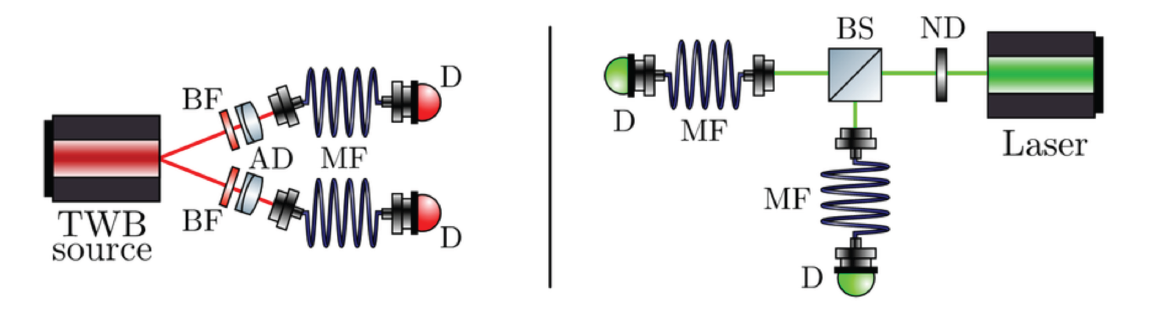
Twin-beam (left) and coherent-state (right) optical layouts: each beam is delivered to a QMPD-2 head and read out by a QuantumBox channel.
Twin-beam (left) and coherent-state (right) optical layouts: each beam is delivered to a QMPD-2 head and read out by a QuantumBox channel.
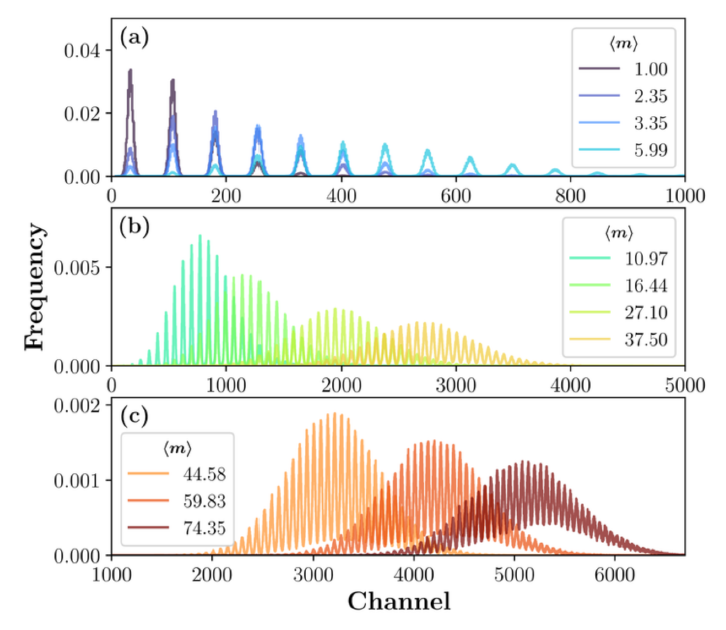
Measured photon-number distributions across the mesoscopic range, from ⟨m⟩ ≈ 1 up to ⟨m⟩ ≈ 74 — individual photon peaks remain resolved well above 50 photons.
Measured photon-number distributions across the mesoscopic range, from ⟨m⟩ ≈ 1 up to ⟨m⟩ ≈ 74 — individual photon peaks remain resolved well above 50 photons.
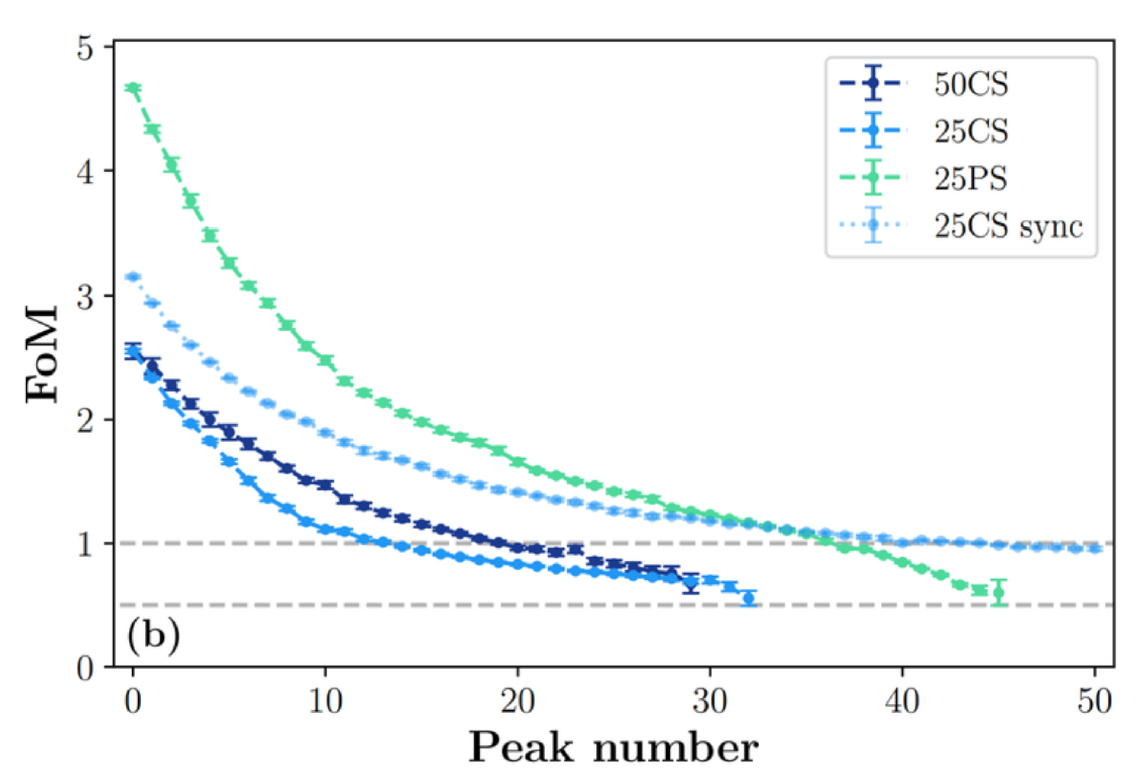
Figure of Merit (peak separation vs. peak width) per photon-number peak: FoM ≥ 1 means peaks remain individually resolvable — here up to ~30–45 photons depending on the SiPM.
Figure of Merit (peak separation vs. peak width) per photon-number peak: FoM ≥ 1 means peaks remain individually resolvable — here up to ~30–45 photons depending on the SiPM.
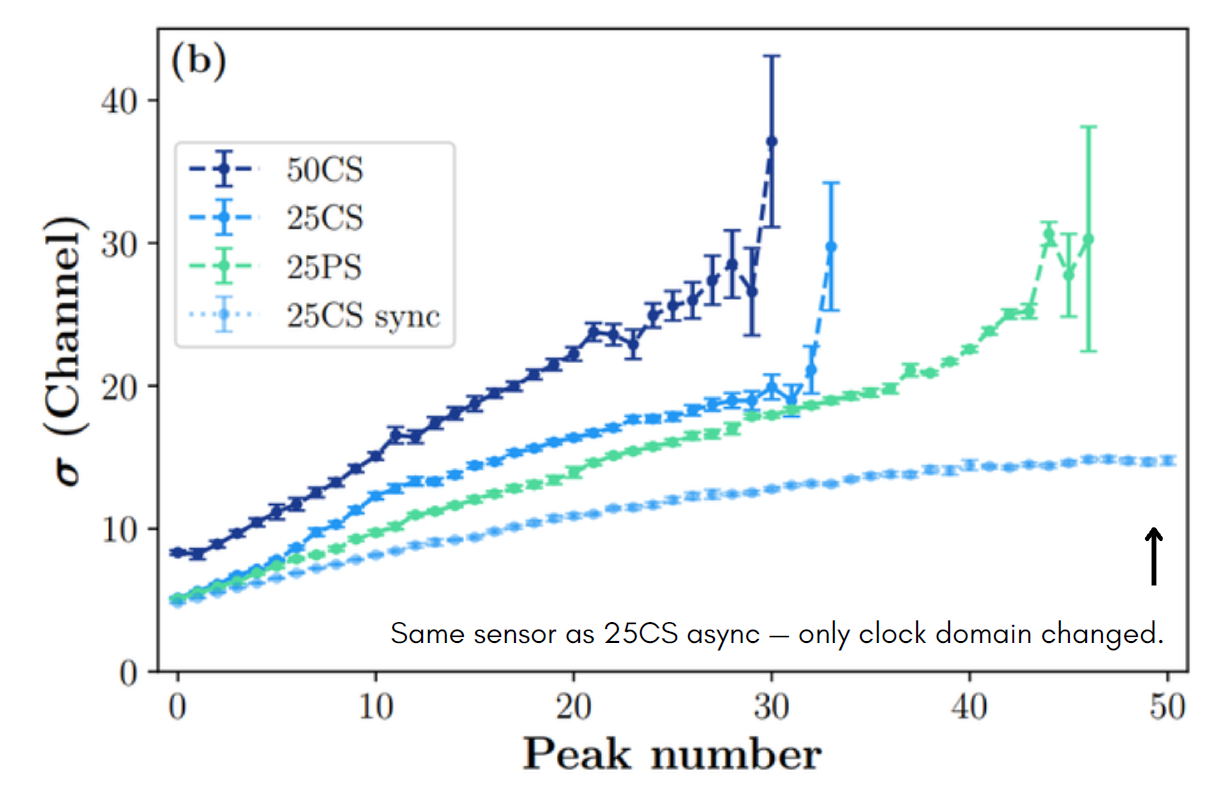
Peak width vs. photon number: operating the digitizer and laser in a single clock domain (sync) dramatically reduces peak broadening, extending the counting range.
Peak width vs. photon number: operating the digitizer and laser in a single clock domain (sync) dramatically reduces peak broadening, extending the counting range.
The System
QuantumBox is a system built from Nuclear Instruments components. Two configurations are available, depending on the digitizer:
Configuration A — QuantumBox with DAQ141-6 (recommended)
DAQ141-6 + QMPD-2 + QUANTA. The DAQ141-6 already integrates the front-end power and control for up to six QMPD-2 heads (programmable bias, ±6 V, TEC, temperature feedback), so it drives the detectors directly — no separate power unit is needed.
Configuration B — QuantumBox with DAQ141
DAQ141 (32-channel) + QMPD-2 + QMPD-1 + QUANTA. The 32-channel DAQ141 does not supply detector bias, so each QMPD-2 head is powered and controlled by a QMPD-1 unit. This configuration scales to many channels for large twin-beam arrays and multi-detector experiments.
For high channel counts, this is the recommended and most cost-effective solution: a single 32-channel DAQ141 reads out many detectors at a far lower cost per channel than equipping several 6-channel DAQ141-6 units, so the saving easily offsets the addition of the per-head QMPD-1 power units.
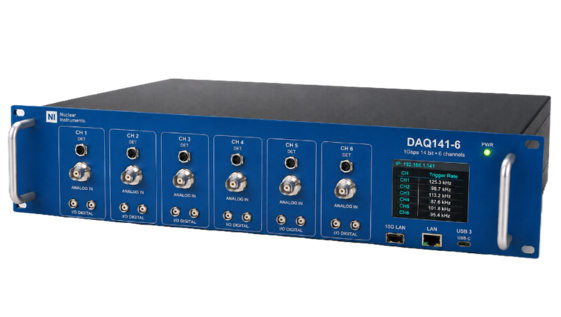
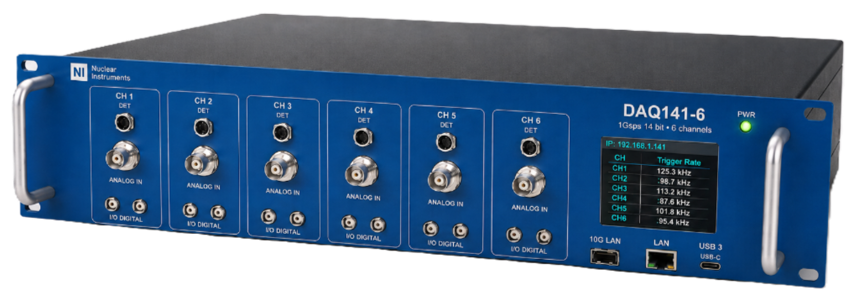
DAQ141-6
6-channel, 14-bit / 1 Gsps digitizer with integrated front-end power and control for up to six detector heads. The self-contained QuantumBox engine — no external bias unit required.
Learn more
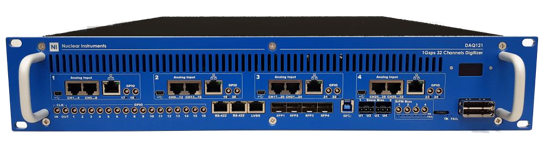
DAQ141
32-channel, 14-bit / 1 Gsps digitizer with fully differential inputs and on-board real-time DSP, for large multi-channel QuantumBox setups and twin-beam arrays.
Learn more
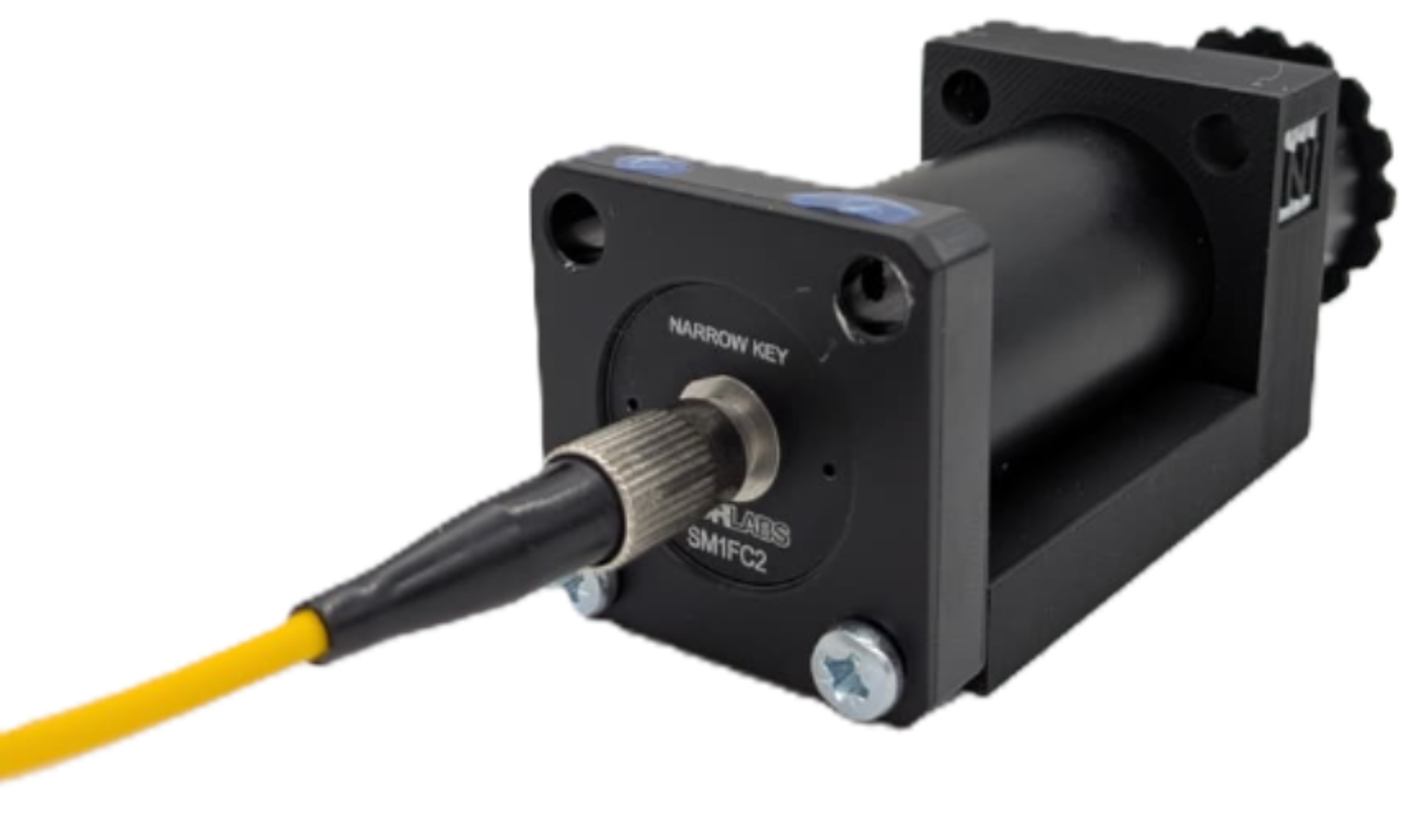
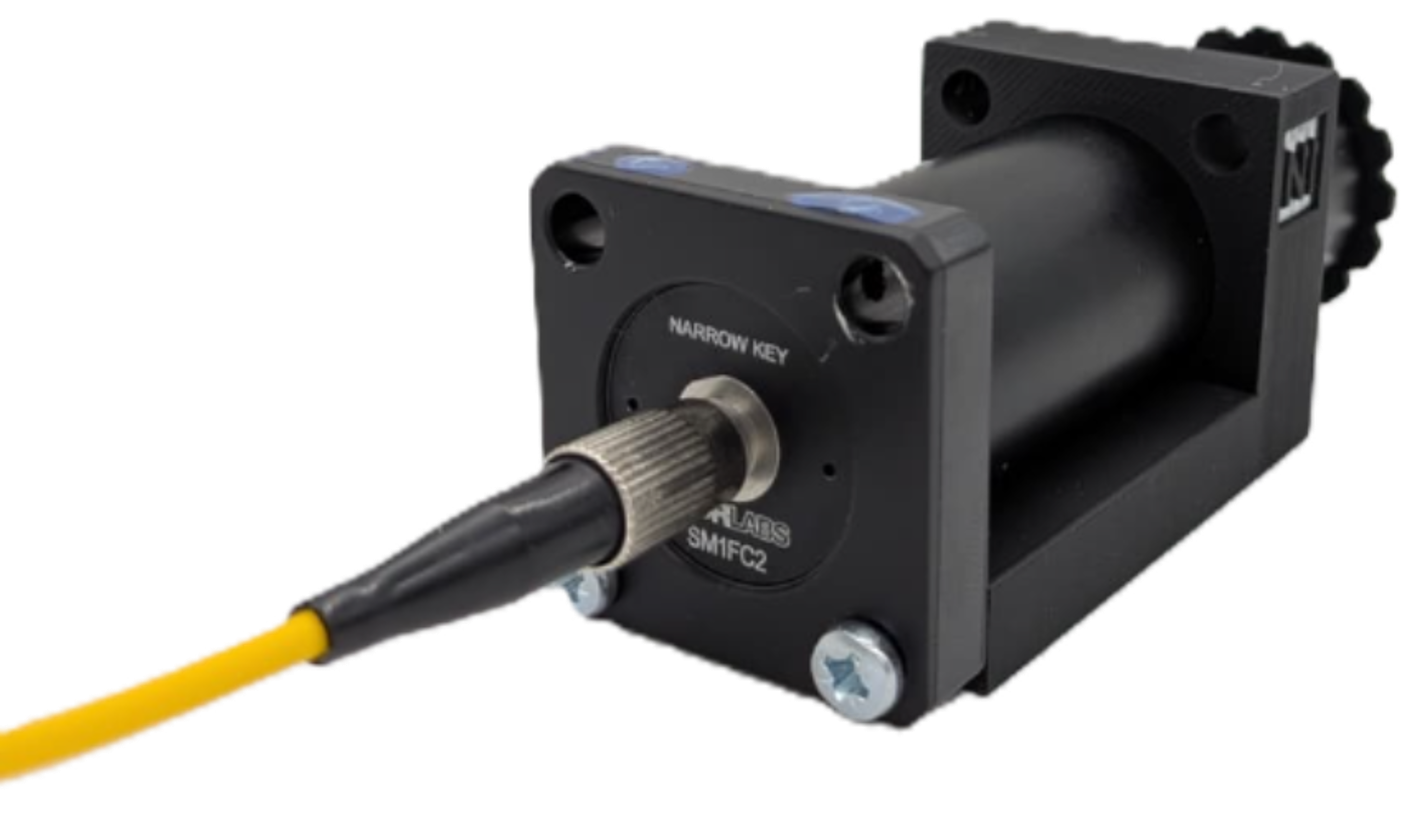
QMPD-2
The SiPM detector head: a 1.3 × 1.3 mm² SiPM with variable-gain transimpedance preamplifier (10–200 p.e. dynamic range) and on-board temperature monitor — fiber-coupled and connected to the digitizer through a single M8 cable.
Learn more
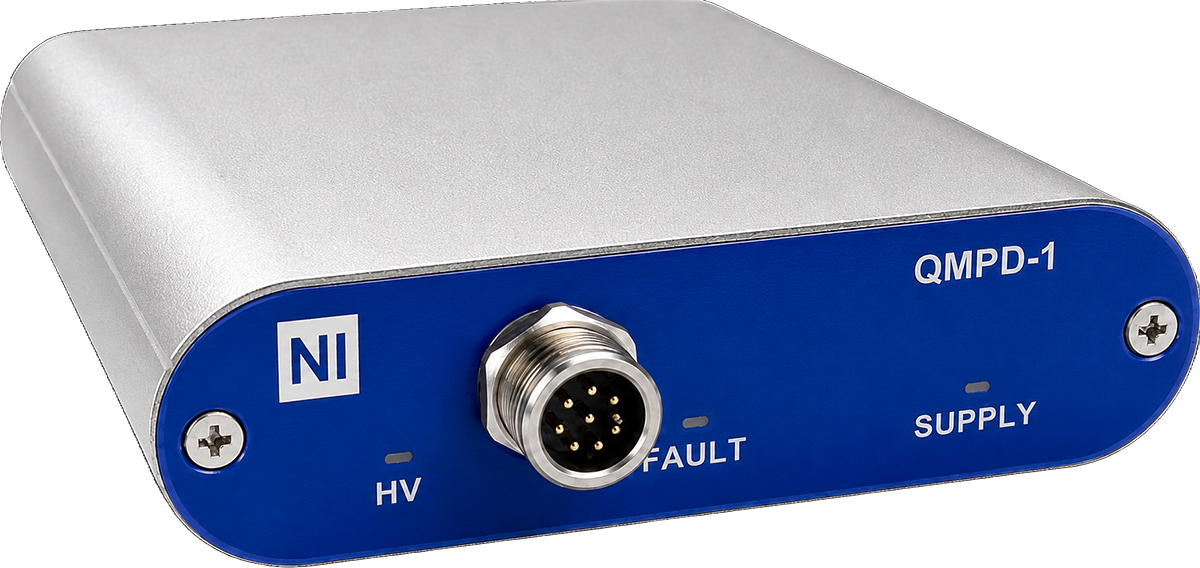
QMPD-1
Front-end power and control unit (HV bias, supply, fault monitoring) for the QMPD-2 head. Required only with the DAQ141 — the DAQ141-6 already powers the detectors directly.
Learn more
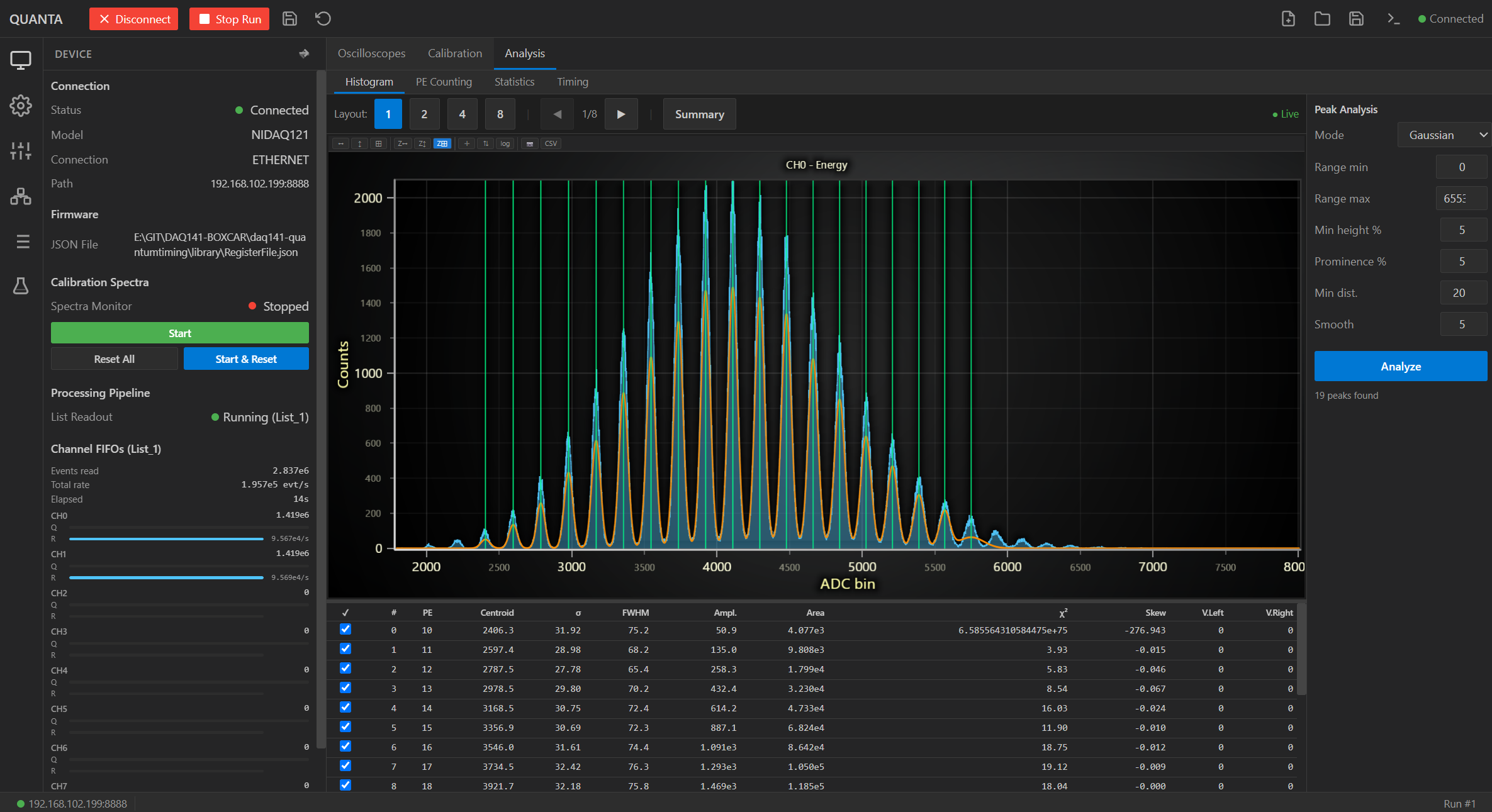
QUANTA
The acquisition & analysis software that drives QuantumBox: real-time photon counting with quantum correlations (g₁₁, NRF, Fano), picosecond photon timing, configurable hardware coincidences and multi-format export — all live, on the same digitizer.
Learn more
QUANTA Software
QUANTA is the photon-counting and time-tagging software that drives QuantumBox. It provides a live oscilloscope and real-time photon-number / energy spectra, full control of every processing parameter (trigger, baseline, deconvolution, QDC gate), the live quantum-correlation and timing analysis, and libraries for automated scans. All photon-number assignment, histogramming, correlation and statistical analysis runs online, so the experiment can be monitored and tuned without stopping the run. → Learn more about QUANTA